Recap: Sacred Ground, Sustainable Future at VAGHC 2026
What We Shared at the 2026 Virginia Governor's Housing Conference
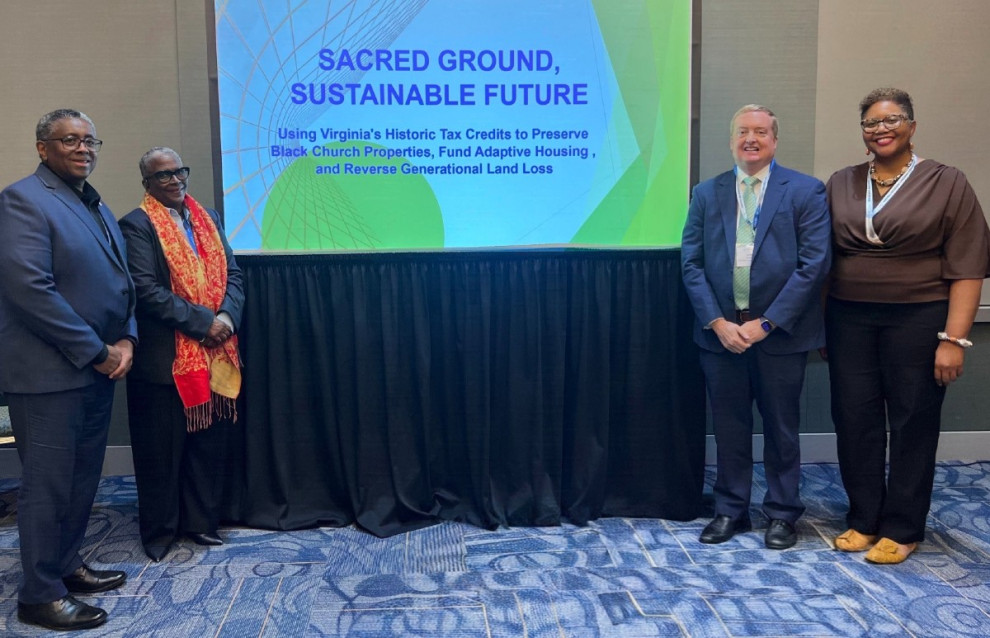
Yesterday, November 18, our panel took the stage at the 2026 Virginia Governor's Housing Conference. The room was full of developers, policymakers, municipal leaders and community advocates. Our topic was one we care about deeply: how Black churches can use Virginia's historic tax credits to preserve their buildings, create housing and keep land in community hands for generations.
Thank you to everyone who attended, asked questions and stayed afterward to talk. Here is what we covered.
Why this matters now
Black churches are the largest institutional landholders in the African American community. At the same time, church membership is declining and Black land ownership across Virginia has fallen sharply. Many congregations are sitting on historic buildings they can no longer afford to maintain.
The good news: the rules are shifting in their favor. Zoning paths for housing on church land are opening up, and Virginia's tax credit program has grown. As we said in the room, this is not a get-rich plan and it is not about vanity. It is about meeting real needs: housing, physical and mental health care, and jobs and career development.
Four lanes, one story
We opened with the story of Rocky Branch School, a two-room schoolhouse built in 1913 and reused to serve the needs of its congregation and community. From there, each panelist took one part of the journey:
- Larry Murphy, Urban Development Corporation (moderator) covered the building itself: assessing condition, assembling the right project team and the realities of renovating historic church buildings. He also stressed the groundwork every church needs first, a separate LLC with firewalls between the project and the congregation, plus solid accounting and reporting systems.
- Sandra Bolling, Historic Tax Credit Specialist explained how the credits work. Virginia offers a 25% state credit on eligible rehabilitation costs. Income-producing buildings can add a 20% federal credit, for up to 45% combined. Projects go through a three-part application with the Virginia Department of Historic Resources.
- Craig Stallings, CPA, Stallings & Associates showed how a church with no tax bill can still benefit. The church forms an LLC, admits tax credit investors, and the investors buy the credits for cash that goes into the project.
- Ebonie Alexander, Black Family Land Trust set the historical stakes. Black Americans owned roughly 14 to 19 million acres around 1920. Today that figure is about 2 million. Church land is among the last large, community-controlled parcels left in many Black neighborhoods.
The numbers we walked through
On a project with $400,000 in eligible rehab costs, the state credit is worth $100,000 and the federal credit $80,000. Sold to investors at about 80 cents on the dollar, that becomes roughly $144,000 in cash for the project. Real pricing depends on the deal and the market, so treat this as an illustration.
The question we heard most
Almost every question came back to one thing: How do we get our church to take this seriously and set up a committee to study it?
Our short answer: start small and start with mission. Ask your pastor and leadership board to appoint a small property-vision committee with a clear charge, such as a 90-day look at what your property could do for your community. Include a trustee, someone with finance or accounting experience, someone who knows the church's history, a younger member and a community voice. Its first job is to learn, not to decide.
We will go deeper on this in our upcoming three-part series. In the meantime, the resources below are a good place to begin.
If your church is ready to talk, contact us. We are glad to help you take the first step.
Helpful resources for your church's first conversation
Included is a resource link | followed by how it helps a new committee.
- Partners for Sacred Places — Transition Services | Questions every congregation should ask about upkeep, partners and the future of its building. Home of the guide Transitioning Older and Historic Sacred Places, which opens with a self-assessment that sparks internal conversation.
- Partners for Sacred Places — Community Engagement | Asset-mapping tools that help a committee see the building as a community asset, plus links to preservation specialists.
- Enterprise Faith-Based Development Initiative | Training and predevelopment support so churches can reach an informed "go or no go" decision on housing. It has helped congregations create over 1,900 homes.
- Enterprise announcement of its 2026 Ohio cohort | A recent example of how a church cohort is selected and supported. Useful to share with leadership.
- Yes In God's Backyard (Tax Credit Advisor) |Plain-language overview of the national movement of congregations building housing. A good first read for a skeptical board.